
Redefine Success
Choosing a chemo wrap is about more than coverage. Learn what to look for in fabric, fit, lining, coverage, comfort, and personal style.
How to Choose a Chemo Wrap: Comfort, Fit & What to Look For
If someone you love is beginning chemotherapy, you may be looking for a comfortable headwrap to give them—or you may be navigating head coverings yourself for the first time.
With so many options available, it can be difficult to know what actually makes one chemo wrap more comfortable than another.
Should you choose cotton? A scarf? A turban? A wrap with a lining? How much coverage is enough? And how do you know what size to order?
The good news is that choosing a chemotherapy headwrap doesn't have to be complicated.
The best place to start is with comfort, fit, and personal preference.
What Is a Chemo Wrap?
A chemo wrap is a soft head covering designed to provide comfortable coverage for someone experiencing hair loss during chemotherapy or other circumstances.
Unlike a traditional scarf that may need to be folded, wrapped, and secured, a purpose-designed headwrap can provide an easier, more comfortable option.
Some people wear headwraps for complete coverage. Others prefer them for a little extra warmth, privacy, or simply because they enjoy how they look.
And importantly, there is no single "right" way to wear one.
Your head covering should work for you.
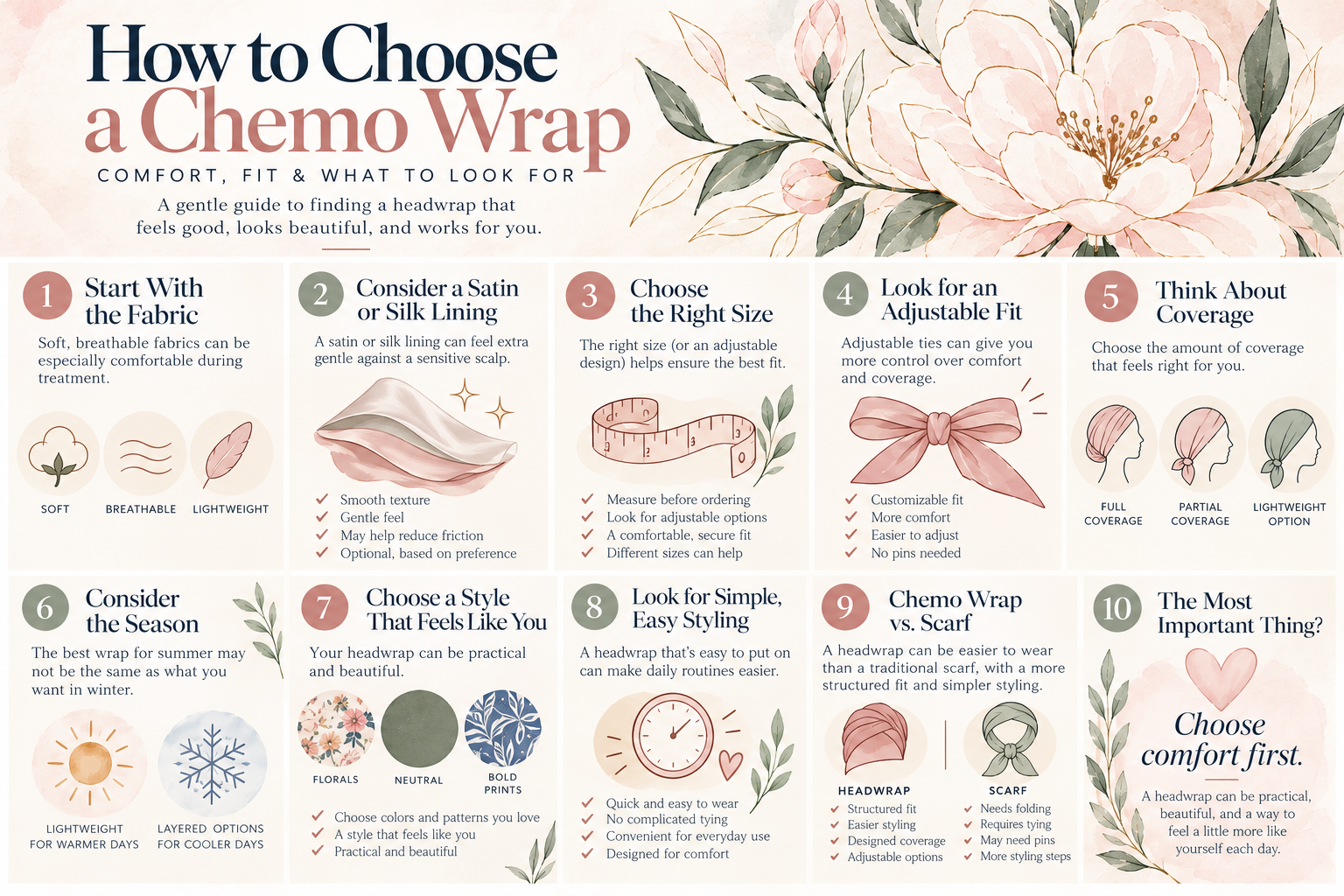
1. Start With the Fabric
When you're choosing a headwrap for chemotherapy, fabric is one of the first things to consider.
A scalp may feel more sensitive than usual during treatment and hair loss, so fabrics that feel soft and comfortable against the skin can be especially appealing.
Look for:
Softness:
The fabric should feel comfortable against the scalp rather than rough or scratchy.
Breathability:
A breathable fabric can be especially nice when you're wearing a headwrap for several hours.
Lightweight construction:
A lighter wrap can be easier to wear around the house, during treatment appointments, or while out and about.
Minimal irritation:
Consider seams, tags, elastic, and anything else that may create pressure or friction.
Cotton and other soft, breathable textiles are popular choices for everyday headwraps. Some people also prefer a smooth satin or silk lining for an especially gentle feel.
There isn't one fabric that is best for everyone. Comfort is personal.
2. Consider a Satin or Silk Lining
If you're looking at chemo headwraps, you'll likely come across options with satin or silk linings.
Why?
A smooth lining can create a different feel against the scalp than unlined fabric.
For someone who is particularly sensitive to texture or friction, a smooth lining may be worth considering.
Silk and satin are also often chosen because they have a smooth surface that can feel gentle against the skin.
If you're buying a headwrap as a gift, a lining can be a thoughtful option—but it isn't essential for everyone.
If you're unsure, prioritize the person's preferences.
3. Choose the Right Size
A headwrap that is too tight can quickly become uncomfortable.
One that is too loose may shift throughout the day.
That's why sizing matters.
Before purchasing a chemo wrap, check the manufacturer's sizing instructions and measure around the head according to their guidelines.
CareKaps offers three general sizes:
Small: 20–22 inches
Regular: 22–28 inches
Large: 28–32 inches
An adjustable design can be especially helpful because it allows the wearer to customize the fit rather than relying on a fixed circumference.
If you're buying a headwrap as a gift
If you don't know the recipient's head measurement, look for an adjustable style.
That gives them more flexibility and can take some of the guesswork out of gifting.
4. Look for an Adjustable Fit
Not everyone wants the same amount of snugness.
Some people like a secure fit. Others prefer something loose and relaxed.
A headwrap with adjustable ties can give the wearer more control over the fit.
This is especially helpful when someone's comfort preferences change throughout the day.
A thoughtfully designed wrap can allow the wearer to adjust the coverage and fit without needing pins or complicated wrapping techniques.
5. Think About How Much Coverage You Want
Head coverings come in many different shapes and styles.
Some provide full coverage. Others leave part of the head or neck exposed.
Before choosing a chemo wrap, think about how the person plans to wear it.
Do they want:
Full head coverage?
Something lightweight for warmer weather?
More coverage around the back?
A wrap they can wear indoors?
Something comfortable for going out?
A stylish accessory that doesn't look overly functional?
There is no wrong answer.
A headwrap can be practical and beautiful.
6. Consider the Season
The best chemo headwrap for summer may not be the same one someone wants in winter.
For warmer weather, look for lightweight and breathable fabrics.
For cooler weather, a slightly heavier fabric or layered option may feel more comfortable.
You may also want different options for different situations.
A lightweight kerchief-style wrap can be wonderful for warmer days, while a fuller wrap may feel better when additional coverage is desired.
7. Think About How It Makes You Feel
This is an important part of choosing a head covering that can easily get overlooked.
A headwrap isn't just about coverage.
It's something you're putting on your body—and potentially wearing in front of other people.
So ask:
Does it feel like me?
Some people want neutral colors.
Some want florals.
Some want bold prints.
Some want something simple and understated.
Others want beautiful colors and patterns that feel like their personal style.
If you're buying a chemo wrap for someone else, consider what they normally wear.
A favorite color, floral pattern, or beautiful textile can make the gift feel much more personal.
8. Look for Simple, Easy Styling
When someone is going through treatment, complicated isn't always better.
A headwrap that can be put on quickly and adjusted easily can become a favorite simply because it is convenient.
Look for designs that don't require complicated folding or tying.
This can be particularly helpful when the wearer is tired or simply wants something easy.
Designed With These Details in Mind
When you know what to look for in a comfortable chemo headwrap, the details begin to matter: soft fabric, an adjustable fit, thoughtful coverage, easy styling, and a design that still feels personal.
That's the philosophy behind CareKaps.
CareKaps are thoughtfully handmade with comfort, adjustability, and personal style in mind. Each wrap is made in small batches with soft fabrics and wide, adjustable ties designed to create a comfortable, personalized fit.
For those who prefer it, select CareKaps can also be made with a smooth satin or silk lining.
The goal isn't to create a head covering that simply works.
It's to create one that feels good to put on—and still feels like you.
Explore the CareKaps Collection →
9. Don't Assume Everyone Wants a Headwrap
If you're purchasing a chemo head covering as a gift, remember that hair loss and treatment are deeply personal.
Some people love headwraps.
Some prefer hats.
Some prefer scarves.
Some don't want to cover their heads at all.
And some may want several options depending on the day.
If you're giving a headwrap as part of a care package, consider making it an invitation rather than an expectation:
"I saw this and thought you might like it. I hope it gives you another comfortable option."
That leaves the choice with them.
Chemo Wrap vs. Scarf: What's the Difference?
A traditional scarf can absolutely be used as a head covering.
However, a purpose-designed headwrap may be easier to wear because the shape, fit, and construction have already been considered.
A scarf may require:
Folding
Wrapping
Tying
Pins or other methods of securing it
A headwrap may offer:
A more structured fit
Adjustable sizing
Easier styling
Designed coverage
A ready-to-wear option
Neither is inherently better.
It's simply a matter of what feels easiest and most comfortable.
What Makes a Good Chemo Headwrap?
When you're comparing different options, consider this simple checklist:
Comfort
Does the fabric feel soft and comfortable?
Breathability
Will it feel comfortable for extended wear?
Fit
Is the sizing appropriate, or is it adjustable?
Coverage
Does it provide the amount of coverage desired?
Construction
Are there unnecessary seams, tags, or pressure points?
Style
Does the color or pattern feel like the wearer?
Versatility
Can it be worn in different ways or for different occasions?
Ease
Can it be put on without complicated styling?
These simple considerations can help you narrow down the choices.
Choosing a Chemo Wrap as a Gift
If you're buying a chemotherapy headwrap for a friend, parent, spouse, sibling, coworker, or loved one, don't feel like you need to know everything about what they're going through.
You don't need to choose the "perfect" wrap.
Instead, choose something that communicates:
I thought about what might make you comfortable.
If you know their favorite colors or patterns, use those clues.
If you know they tend to get warm easily, look for something lightweight.
If they prefer soft textures, consider a smooth-lined option.
And if you don't know their preferences, an adjustable, versatile style is often a thoughtful place to start.
A Note About Comfort During Treatment
Everyone's experience with chemotherapy is different.
What feels comfortable for one person may not feel comfortable for another.
A headwrap is not a treatment, and it shouldn't be marketed as one. Its purpose is simply to provide a comfortable option for head coverage and personal style.
If someone has specific concerns about their scalp, skin, or what products are appropriate during treatment, their healthcare team is the best source of guidance.
The Most Important Thing?
Choose comfort first.
Then choose the color.
Then choose the style.
A headwrap can be something deeply practical—but it can also be something beautiful.
It can be a favorite floral.
A meaningful color.
A soft textile.
A simple piece that makes getting dressed feel a little easier.
And sometimes, having something that feels good to put on can make a difficult day feel just a little more manageable.
A Headwrap Should Feel Like You
CareKaps were created around a simple idea: comfort doesn't have to mean giving up your personal style.
From soft florals and beautiful solids to special textiles and lightweight options, CareKaps are designed to give you choices—because the headwrap you reach for should feel like something you genuinely want to wear.
Thoughtfully handmade in small batches, each CareKap is made with comfort and individuality in mind.
Whether you're choosing one for yourself or sending one to someone you love, we hope it becomes more than just a head covering.
We hope it becomes a small piece of comfort.
Explore the CareKaps Collection →
Next in the series
What to Expect When Hair Loss Begins: A Gentle Guide for the First Few Weeks
We'll talk about what people often experience as hair loss begins, what can make the transition more comfortable, and how to prepare without feeling overwhelmed.

Small Steps Create Big Shifts
It All Begins Here
Confidence doesn’t always arrive with a bold entrance. Sometimes, it builds quietly, step by step, as we show up for ourselves day after day. It grows when we choose to try, even when we’re unsure of the outcome. Every time you take action despite self-doubt, you reinforce the belief that you’re capable. Confidence isn’t about having all the answers — it’s about trusting that you can figure it out along the way.
The key to making things happen isn’t waiting for the perfect moment; it’s starting with what you have, where you are. Big goals can feel overwhelming when viewed all at once, but momentum builds through small, consistent action. Whether you’re working toward a personal milestone or a professional dream, progress comes from showing up — not perfectly, but persistently. Action creates clarity, and over time, those steps forward add up to something real.
You don’t need to be fearless to reach your goals, you just need to be willing. Willing to try, willing to learn, and willing to believe that you’re capable of more than you know. The road may not always be smooth, but growth rarely is. What matters most is that you keep going, keep learning, and keep believing in the version of yourself you’re becoming.

Turn Intention Into Action
It All Begins Here
Confidence doesn’t always arrive with a bold entrance. Sometimes, it builds quietly, step by step, as we show up for ourselves day after day. It grows when we choose to try, even when we’re unsure of the outcome. Every time you take action despite self-doubt, you reinforce the belief that you’re capable. Confidence isn’t about having all the answers — it’s about trusting that you can figure it out along the way.
The key to making things happen isn’t waiting for the perfect moment; it’s starting with what you have, where you are. Big goals can feel overwhelming when viewed all at once, but momentum builds through small, consistent action. Whether you’re working toward a personal milestone or a professional dream, progress comes from showing up — not perfectly, but persistently. Action creates clarity, and over time, those steps forward add up to something real.
You don’t need to be fearless to reach your goals, you just need to be willing. Willing to try, willing to learn, and willing to believe that you’re capable of more than you know. The road may not always be smooth, but growth rarely is. What matters most is that you keep going, keep learning, and keep believing in the version of yourself you’re becoming.

Make Room for Growth
It All Begins Here
Confidence doesn’t always arrive with a bold entrance. Sometimes, it builds quietly, step by step, as we show up for ourselves day after day. It grows when we choose to try, even when we’re unsure of the outcome. Every time you take action despite self-doubt, you reinforce the belief that you’re capable. Confidence isn’t about having all the answers — it’s about trusting that you can figure it out along the way.
The key to making things happen isn’t waiting for the perfect moment; it’s starting with what you have, where you are. Big goals can feel overwhelming when viewed all at once, but momentum builds through small, consistent action. Whether you’re working toward a personal milestone or a professional dream, progress comes from showing up — not perfectly, but persistently. Action creates clarity, and over time, those steps forward add up to something real.
You don’t need to be fearless to reach your goals, you just need to be willing. Willing to try, willing to learn, and willing to believe that you’re capable of more than you know. The road may not always be smooth, but growth rarely is. What matters most is that you keep going, keep learning, and keep believing in the version of yourself you’re becoming.